I play Doomsday: Last Survivors, a zombie strategy game where everything hangs on which heroes you pair up: a leader and an assistant per squad, five squads to an arena lineup. My notes on which pairs to build started as a single HTML page. They are now a 12-tab guide with its own arena meta tracker, a lineup optimiser and per-account profiles, live at doomsday-hero-guide.sidspanos.me.
The question I actually wanted answered
Every guide tells you the best lineup in the game. That’s useless if you don’t own half of it. What I wanted was narrower: given the heroes on my account, what are the top players running, and what’s the closest I can field?
The game has no API. Reading its memory or sniffing its network traffic would break the terms of service and is exactly what anti-cheat looks for, so that was never an option. Everything here comes from screenshots.
Screenshots in, meta out
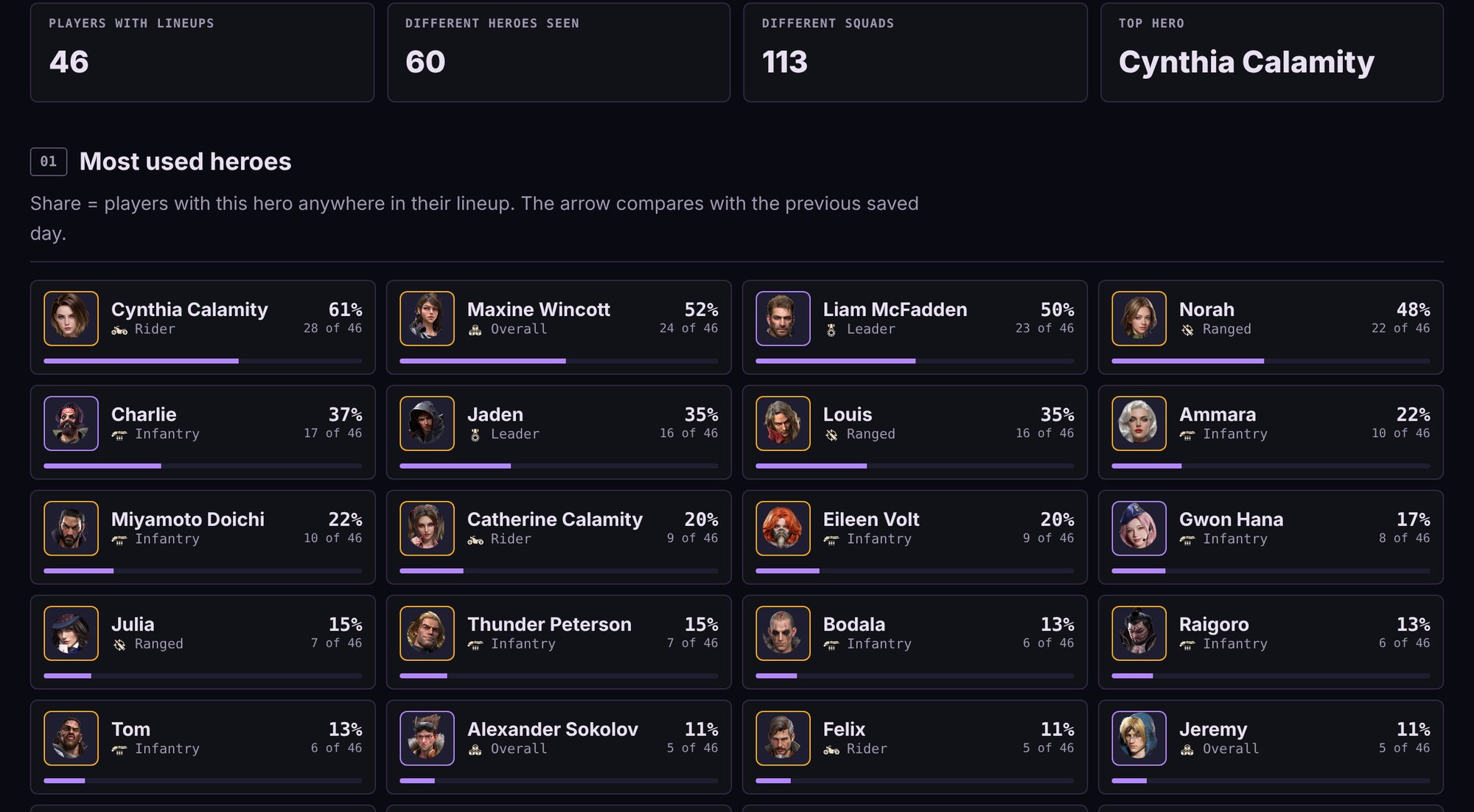
A capture tool reads the Arena of Glory rankings off the game screen and recognises each hero from their portrait. Each capture day is saved as a small meta.json. The guide merges the days so every player counts once, using their latest capture. That matters because it’s mostly the same 20-odd players at the top every day, and I only re-capture the ones whose lineup changed.
So far that’s 46 top players, 60 different heroes and 113 different squads. The Arena Meta tab turns it into most-used heroes, most-used pairs, day-on-day trends and a players table that links back to the screenshot each lineup came from.
The lineup builder
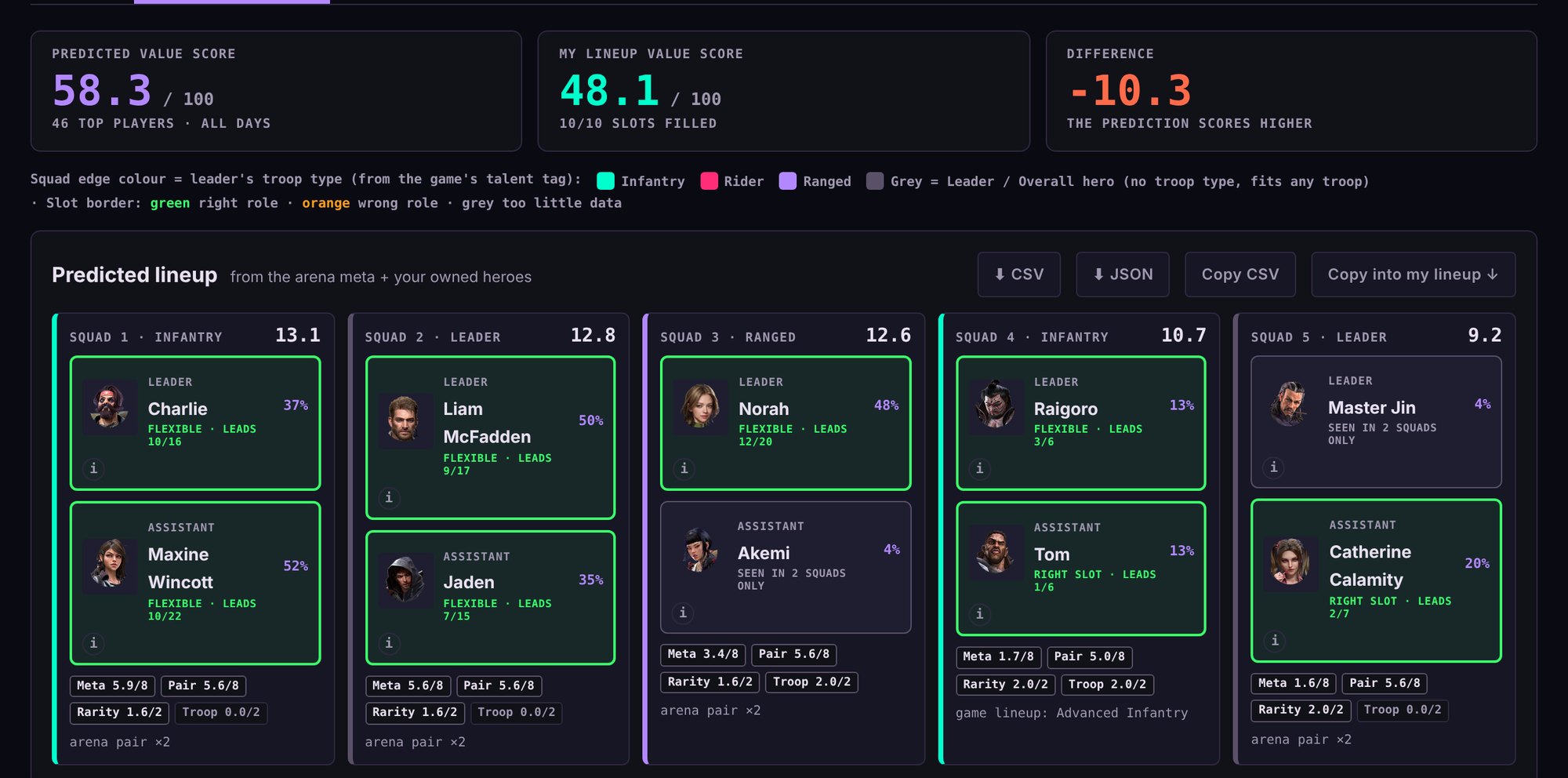
This is the part I use the most. I mark which heroes I own, and the Roster tab builds a predicted lineup from them: it tries the combinations of my heroes and keeps the five squads with the highest total value score. Next to it is my lineup, which I fill by drag and drop, paste in as CSV, or copy across from the prediction and tweak. Both get scored, and the difference between them is the first number on the page.
Each squad scores out of 20, so a full lineup is out of 100:
- Meta, up to 8: how many top players run each hero.
- Pair, up to 8: whether top players actually field this leader + assistant pair, or the game itself recommends it.
- Rarity, up to 2 and troop match, up to 2.
- Role, −1 per slot: a hero that top players nearly always use as leader, placed as assistant, or the other way round.
That role check turned out to be the most useful visual. Every slot goes green when the hero sits where top players put them and orange when it doesn’t. Cynthia Calamity, for example, leads 20 of the 22 squads she appears in. Drop her in an assistant slot and it lights up straight away.
What else grew around it
- Character sheets for every hero, with skills, talent trees, skins and the hero’s own animation in place of a static portrait.
- Arena focus tracking: one click marks the heroes I’m currently levelling for arena. The F2P tab, the hero tray and the roster all show the same list.
- A farming lineup built from my Zombie Hunter heroes, with my arena focus heroes as assistants so they level up while I farm.
- Profiles for more than one account. Switching is one click, and every tab recalculates for whoever is active.
- Export and import in CSV or JSON for owned heroes, lineups and all settings. The guide stores everything in the browser, so this is how it moves between machines.
The tech stack
Deliberately boring. No framework, no database, no server of my own.
- Front end: plain HTML, CSS and vanilla JavaScript. Each of the 12 tabs is its own HTML page, and they are combined into one
index.htmlwhere every tab shares the same browser storage. - Build: a Python 3 script, standard library only (
src/build.py). It stitches the tabs together and bakes in the hero data, the game’s own lineups and the latest arena meta. Same input, same output, so git only sees real changes. - Data: JSON files. Hero data and lineups from the game files, plus one
meta.jsonper capture day from the screenshot tool. - Animations: the Spine web player runs each hero’s own animation on their character sheet.
- User data: browser localStorage, split per profile, with CSV/JSON export and import to move it between machines.
- Source control: Git and GitHub. The whole project, art and captures included, lives in one repo.
- Hosting: Cloudflare Pages, on its own subdomain of sidspanos.me with Cloudflare DNS and automatic SSL.
From git push to live site
Cloudflare Pages is connected straight to the GitHub repo, so publishing is a side effect of committing. There’s no deploy button, no GitHub Actions workflow and no API token to look after.
- Change something locally: edit a tab in
src/, or drop a new capture day intometa/. Check it onlocalhostfirst. - Commit and push to the
mainbranch on GitHub. - Cloudflare sees the push and starts a build on its own servers.
- The build runs one script (
src/cf-build.sh): it rebuildsindex.htmlwith Python and copies the site into adistfolder, leaving out the build files. - Cloudflare publishes it to its edge network, and doomsday-hero-guide.sidspanos.me serves the new version a minute or two after the push.
Every deployment is kept, with its own preview URL, so a bad push is one click away from being rolled back in the Cloudflare dashboard. Updating the arena meta is now: copy the new capture day in, commit, push. The site does the rest.
I built it with Claude over a few long sessions. My part was the game knowledge and saying “no, that’s wrong” a lot.
Honest status
- The score measures popularity, not strength. About 80% of it is “how often top players use this”. A hero can be common because it was free in an event, not because it’s good.
- Low use doesn’t mean weak. Master Jin shows up in about 4% of lineups. He’s a siege hero and hard to get, so arena simply isn’t his job.
- 46 players is a small sample. A pair seen twice beats a pair seen once, and that difference is one screenshot.
- No hero levels. Without an API there’s no way to read my heroes’ stars or power, so a fresh Legendary still outscores a maxed-out Elite.
- The hero art belongs to the game’s publisher. I’m working on getting permission to use it.
Why bother
Because a spreadsheet of “best heroes” doesn’t tell me what to do on my account tonight, and this does. It’s also a good reminder that most useful tools are a pile of small decisions: what to count, what not to trust, and saying out loud where the numbers stop meaning anything.