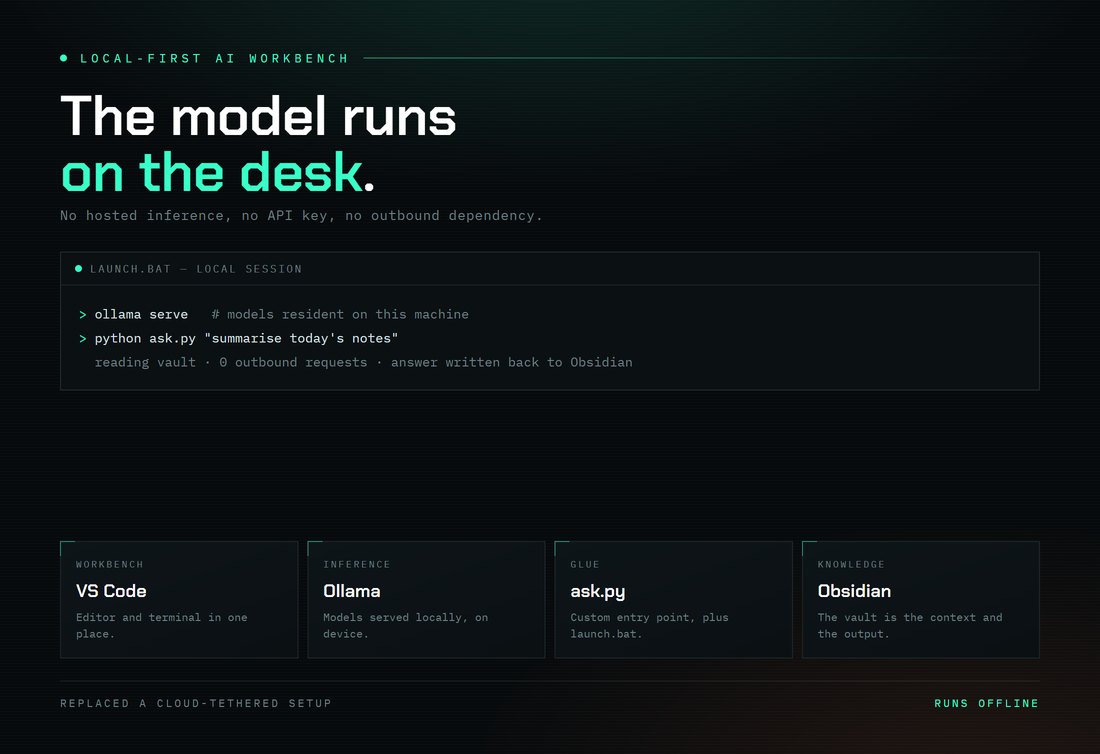
Context: Local tooling
The question
How can an editor, local model runtime and repeatable commands work together without depending on hosted inference?
The approach
VS Code provides the development workbench, Ollama serves models on-device, and custom command buttons on a Stream Deck expose cross-platform operations.
Offline operation is the constraint
The environment is built to run without a hosted inference provider. Model serving stays on the device, while the command surface provides a direct way to invoke the tools used in the workflow.
Result and limits
The workbench brings VS Code, Ollama and a physical command surface into the same workflow. Its value is control over where inference runs and a direct route to recurring operations.
Local inference still depends on the models and hardware available. This case describes the integration; it does not establish a performance advantage, model-quality benchmark or complete offline software supply chain.
Related work
The clean-machine workstation rebuild explores a related question: which parts of a working environment can be reconstructed, and which identities and data need separate recovery?
Skills in practice
- Local inference: integrating on-device model serving into the development environment.
- Tool integration: connecting the editor, model runtime and custom commands.
- Operational ergonomics: making repeatable commands available through a physical control surface.