Context: Interactive archive
The question
How can a family archive help someone follow the relationships between a person, a place and a memory?
The approach
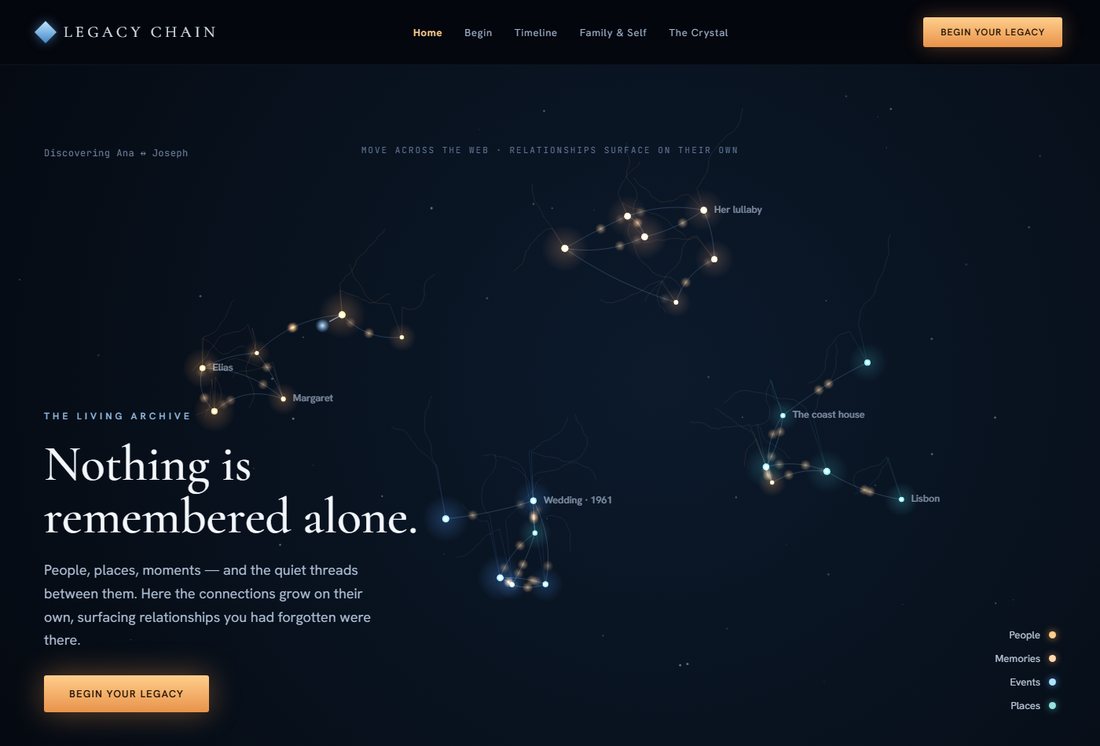
Legacy Chain treats a memory as something attached to people and places. People, events, places and memories appear as nodes in a slowly drifting constellation, with relationships surfacing as you explore.
More than one way into the same story
The constellation sits alongside a timeline, family and self views, and a guided path for adding material. A wedding in 1961, a lullaby, a coast house and a city can be explored through their connections rather than as isolated entries.
What the interface demonstrates
The design offers several routes into connected material: spatial exploration, chronology and a guided contribution path. Each route presents a different way to reach the same stories.
Status and limits
This is an interface experiment. The documented views demonstrate the interaction idea; they do not establish sustained family use, archival durability or a tested backup and recovery process.
Skills in practice
- Information architecture: organising different kinds of family material around the relationships between them.
- Interaction design: giving the reader a spatial view and a chronological view of the archive.
- Contribution flow: a guided route for adding a memory to the existing web of people and places.
The interface follows one premise: nothing is remembered alone.